DOMESTIC HELP
To ease the woman’s workload, the more affluent households employed maids and other domestics, both Jews and non-Jews. The terms and conditions of Jewish maids’ employment were first regulated by the Lithuanian Council, and later by the community. [21] Those who took such employment included widows, orphans, children of broken homes, women from the hekdesh, and other poor, stranded individuals. Since some of them had no home, they resided with their employer, but not everyone wanted live-in help. It was feared — and such fears were sometimes justified — that the presence of a young unmarried woman in the house would attract undesirable types, or prove too tempting for the family’s young boys.
Problems of another kind attended the hiring of Christians as domestics. Throughout the centuries, the Catholic church forbade its members to work as servants in Jewish homes. Periodically these prohibitions were eased, only to be enforced with new vigor by the church and other authorities whenever it suited them. Such restrictions notwithstanding, Christians were always being employed by Jews, which often resulted in conflict with anti-Semitic local authorities. To minimize the tension, the Jews themselves tried to curtail the practice of employing Christians, as a look at some of the seventeenth-century legislation of the Lithuanian Council makes apparent. Duration of employment was limited to one year, and the number of people who could be employed by any one household was restricted. Employment of Christian servants had to be approved and regulated by the community. [22]
Things apparently improved — marginally, to be sure — in the course of the next couple of hundred years. In Eishyshok, sometime during the first half of the nineteenth century, a local Christian woman was hired as a wet nurse for an infant Jewish boy named Todrus. But when the tsarist authorities got wind of it, they took the family to court, where their case made its slow and tortuous way through the legal labyrinth for several decades. The family was victorious in the end, though Todrus was by then a grandfather. “Todrus may nurse” was the verdict — a phrase that came to stand as shorthand for any kind of bureaucratic inefficiency in general, and that of the tsarist judicial system in particular.
The practice of hiring Christian servants had a long history in Eishyshok, with some families maintaining bonds with generations of Christian employees, bonds that endured even into the Holocaust. Kashka, the Polish Catholic maid who helped raise eight of the boisterous children born to Hayya and Shael Sonenson, was so devoted to her charges that she even made regular visits to the grave of one little Sonenson boy who died in infancy. Kashka was fluent in Yiddish, could sing Yiddish songs, and knew all the Jewish rituals concerning the dietary laws as well as those governing all the other aspects of weekday and holiday life in a Jewish household. Having come to the Sonensons by way of her mother, who had been Hayya’s maid at an earlier period in her life, she passed on the legacy of ties to this one family when her granddaughter Jasza became a maid in Shalom Sonenson’s house.
Jasza helped Shalom’s wife Miriam raise their two daughters, Gittele and Shula. She even learned some Hebrew, since Shalom often spoke it to his little girls. During the massacre of September 1941, Jasza risked her own life by helping the family hide, then put herself in mortal danger again when she smuggled food into Ghetto Radun, where Shalom and his family were incarcerated for nine months.
DAUGHTERS
A woman’s greatest helpers and most trusted allies, both at home and in her business, were her daughters. An old shtetl proverb sums up the feeling about the mother-daughter relationship: “If a woman gives birth only to sons, she probably does not deserve to bear daughters.”
Until World War I, when compulsory education for Jewish girls in the Russian empire was introduced (in Eishyshok and other Lithuanian communities it was first instituted during the German occupation), girls were always at home, while their brothers were at school or apprenticing in a trade. From early childhood on, girls assisted their mother with all the chores: at home, in the garden, with the livestock, and in the family business enterprise. As they grew older they were made responsible for their younger siblings. And always they were expected to be mature and reliable.
While daughters were their mother’s greatest helpers, they were also her greatest concern. Protecting the chastity, the morals, and the reputation of a young girl was a constant preoccupation, for anything less than ceaseless vigilance might endanger the girl’s chances of making a good match. Thus a daughter was expected to be at her mother’s side at all times — a virtual impossibility, given the nature of her many duties. Girls and young women were often alone in the store or the market, or even on the road. Zivia Hutner, the granddaughter of Eishyshok rabbi Zundl Hutner, traveled back and forth to Vilna on business beginning in early adolescence, and sewing machine salesman Szeina Blacharowicz traveled the countryside at about the same age. Though it was out of concern for the morals of these spunky entrepreneurs that Haskalah writers were so vehement about keeping girls and women out of commerce, their recommendations were not follows — if only because the girls played too important a role to be banished. [23]
The shtetl had its own ways of guarding the reputations of its young women. For example, if a girl’s hymen broke due to an accident, the details of the event were entered in the shtetl record book, and the family was given a special certificate, signed by the rabbi or the dayyan, attesting to the girl’s purity. Surviving fragments from the record book of one of the Lithuanian shtetlekh include descriptions of three such incidents. Seven-year-old Miriam, daughter, of Hannah and Zvi the tailor, was pushed into a ditch by her girlfriends; two other girls, both teenagers, fell on thus-and-such a day, we are informed, and in thus-and-such a manner. [24] During the Big Fire of 1895, when the entire shtetl of Eishyshok burned down, one girl’s virginity-loss certificate went up in the flames. Though her family had lost everything, it was this piece of paper that most concerned them, and they rushed to Reb Layzer Wilkanski, the shtetl dayyan, to ask him to issue a new certificate. [25]
The close surveillance and stringent expectations paid off. Most shtetl girls were indeed obedient, chaste, hardworking, religious. Nonetheless, there was a tradition in literature and folklore depicting the renegade daughter: She married out of the faith; or she married a non-religious man; or she escaped her mother’s watchful eye by fleeing to the big city; or she in any one of a wide variety of other ways brought shame upon her family. By the twentieth century these girls were not just characters in literature, but, increasingly, figures drawn from life. Even Eishyshok had a few, though they remained very much the minority, as they did in most places.
Still, parents lived in constant fear that their daughters would be labeled damaged goods and live out their lives as old maids (or “gray braids,” as they were known). Obsessed with marrying them off as early as possible, they began preparing their daughters’ trousseaux practically at birth, and agonized greatly over the cost of dowry and kest arrangements when it came time to settle the terms of the betrothal agreement. The fear of spinsterhood, considered the ultimate shame, prompted many parents to rush into marriage arrangements that were not always in the best interests of their daughters. Of course, it was not jut shame that motivated them; a daughter was felt to be an economic burden. Even though the cost of her upkeep must surely have been more than compensated by her household labor, the word on daughters was that they “eat by day and grow by night” — ceaselessly consuming food and clothes.
The mixed messages a girl received about herself from her family and her community were in stark contrast to the very clearly positive status her brother enjoyed. From birth, the male was honored and cherished: his many life-passage celebrations brought joy to his parents’ home; his heder and later yeshivah accomplishments were sources of pride for them; he would recite the Kaddish for them when they were dead.
SISTERS AND BROTHERS
|
| A girl knew that she had to take care of her brother — give him the best pair of shoes to go to heder, deliver a warm meal to him at lunchtime, offer him his choice of foods when he came home. If for some reason he needed any kind of special care or assistance, she might also be expected to stay by his side throughout the school day. For example, Rabbi Isser Zalman Meltzer of Mir (1870-1953), the only surviving male child in his family, went to heder each day in the company of his sister Fruma-Rivka. All his brothers having died in infancy, he had an entire household focused on maintaining his health and well-being, and his sister’s ministrations were part of that campaign. He became a great Talmudic scholar and lived a long life. [26] |
A sister was her brother’s
lifelong nurturer. He knew that in time of need, he could
always turn to her. This Eastern European conception of
sibling relationships was in sharp contrast to the practice
in Mediterranean countries, where it was the role of the
brother to protect his sister. But shtetl boys did value
their sisters, and were expected to demonstrate their affection.
Hence the many little gifts the heder boys made for their
sisters at holiday time: the Hanukkah dreidels, the fruit
pit jewelry for Tu Bishvat, the flag for Simhat Torah, the
scroll of Esther for Purim.
With mothers so overworked, having little time to lavish
affection on their children, the sister-brother relationship
was a particularly important one, a source of emotional
sustenance for each. Though the educational and social patterns
of shtetl life afforded them little time to be in each other’s
company, what time they did have was precious to them; they
played together on the Sabbath and holidays, and whenever
else they could.
At the dawn of the twentieth century, the sister-brother
relationship began to change, along with everything else.
Now that girls could go to school, could embark on their
own journeys of self-improvement and exploration, their
brothers increasingly saw it as their duty to help them
along the way. They felt responsible for molding their sisters’
character, for guiding them intellectually. In this as in
so many other social changes, the Wilkanskis were in the
vanguard.
Yitzhak and Meir devoted much time to their sisters Sarah,
Esther,
and Leah, encouraging them in their eager pursuit of education,
advising them, and even helping them out financially from
their own very limited resources. The girls’ moral
development was also on their minds, as one of Yitzhak’s
letters to ten-year-old Leah in 1904 reveals. Writing from
Berlin, where he was a student, he admonishes her for her
complaint about the brevity of his letters, then goes on
to advise: “If you want to be rewarded, you must also
learn to give to others.” A couple of decades later,
Shaul Kaleko would help his sister, Rachel, to make an illegal
border crossing from Poland into Lithuania. He wanted her
to join him in Kovno, where she would be able to continue
her studies at the excellent Hebrew gymnasium of Reali,
while remaining under his watchful eye.
|
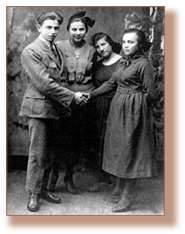
Zisl
Bastunski (left) holding the
hand of sister Altke. In the center
are two friends. Zisl emigrated to
America in 1921. Until World War II
he sent money to his siblings and
parents who remained in Europe.
Altke and her family were murdered
in the September 1941 massacre.
Photo: Yitzhak Uri Katz.
YESC, Bastunski.
|
_______________________
|
|
|
| 21 |
Pinkas
Vaad ha-Kehilot be-Lita, 1628/128;1632/258.
|
| 22 |
Ibid.,
1629/145-146, 1634/281.
|
| 23 |
Mordekhai
Aaron Guenzburg (1795-1846), one of the leading spokesmen
for the Haskalah in Vilna, was active in the attempt to
remove girls and women from commerce, out of concern for
their moral well-being. See Guenzburg, Kiryat Sefer,
p. 59.
|
| 24 |
From
the beth din pinkas of Williampole (Vilijampole), Lithuania.
The Central Archives of the Jewish People, Jerusalem, RU/82.
|
| 25 |
Wilkanski,
Ba-Heder, p. 122. Interview with Rifka Remz.
|
| 26 |
Y.
Meltzer, Be-Derekh
Etz ha-Hayyim, vol.
I, p. 16.
|
|
|
« Previous Page | Next Page » |
|
UP
|