STEP-SIBLINGS AND ORPHAN RELATIVES
During the eighteenth and nineteenth centuries and the first two decades of the twentieth, perhaps as many as two-thirds of the marriages in the shtetl were second, third, and even fourth marriages. Death rather than divorce was responsible for this high remarriage rate, and death also created a large number of orphans. Since many spouses brought with them the children from previous unions, the result was that many if not most shtetl households were filled with stepchildren, and often with distantly related orphans too. This was particularly true in Eishyshok, which had no orphanage because the kahal had stipulated that orphans be sent to their relatives instead.
Sometimes this worked out well. Miriam Kaplan, for example, was taken in by Alte Paltiel and her husband Hayyim, the shtetl dayyan, during World War I. Miriam’s father had gone off to America, where he opened a soda shop with the hope of making enough money to send for his wife and infant child. When his business failed and World War I broke out, the few dollars he had been able to send stopped coming, and Miriam and her mother moved in with her mother’s father, a miller in a small village near Eishyshok. One day a hunting party of German soldiers mistook the miller for an animal and shot him. When his daughter saw the accident through her window, she ran out into the snow to try to save him, wearing only her dress and slippers. She caught a cold that developed into pneumonia; she died only a few days after her father, leaving her little daughter Miriam for all intents and purposes an orphan, for nothing was ever again heard from Miriam’s father. Though Alte Paltiel was only a distant relative, she took Miriam in, and raised her with great love.
|
The typhus epidemic of 1917–1919 claimed hundreds of lives in Eishyshok, leaving many orphans behind. Many of them were not so fortunate as Miriam, for Alte Paltiel was unusual — if not in her willingness to shoulder a family obligation, then certainly in the loving way she did it. An orphan or a stepchild was often considered an onerous burden, and resented accordingly. The mother of Shneur Glombocki, knowing that her days were numbered, summoned the shtetl rabbi to her deathbed. With Rabbi Zundl Hutner in attendance, she spoke to her father and her husband and made them promise that the baby boy would not be raised by a stepmother, for the thought of her beloved child in the care of her husband’s second wife was unbearable to her.
|
Her father had to agree to take the baby in after her death, which he did. And just as the mother had predicted, the boy’s father took no interest in him after he remarried, nor did his new wife or the children from that second marriage, even though they all lived in Eishyshok. As the saying went, “Der foter is getrai vi lang di mame is derbai” (The father is faithful as long as the mother is around).
|
ASSIGNED ROLES: FROM CRADLE TO GRAVE
As stories like that one reveal, these multigenerational multifamily households were not always the warm, loving, cohesive units we know from myth and idealized memory. One way of dealing with the potentially overwhelming complexities of life in the shtetl’s crowded, often impoverished homes was to assign roles to everyone, thus imposing a kind of crude order on the messiness of reality. With typical shtetl bluntness, each person was labeled, his or her future predicted, his status as a winner or loser virtually preordained, with no options for escape. The clever child was identified as the scholar in the family, the “future cabinet member,” while the slow one was said to have been “last in line when God granted brains”; the clumsy child had “hands of clay”; the one with calf eyes as “the beast.”
A bright, attractive child was considered a good reflection on the family, and put on display, while the others were kept out of sight. If a marriage was being arranged, for example, and the prospective in-laws were coming to conduct the negotiations, the family’s “winners” were brought out to greet the guests, while less impressive family members, certainly including anyone with handicaps, stayed behind closed doors. In Hayya and Shael Sonenson’s family, for example, Shalom was chosen over his seven siblings to represent the family, although he was not the brightest. None of the children were unattractive, but with his blue eyes, blond curls, and captivating, dimpled smile, Shalom was picture-perfect, and his parents always used to take only him to family celebrations in other shtetlekh, without any thought to how the other children would feel.
Reinforcing the tendency to assign everybody a label were the economic difficulties faced by so many families. The hand-to-mouth existence they lived dictated that choices be made and life paths mapped out with maximum efficiency. Thus bright boys were seen as a good investment, and as such were sent to the best heder and yeshivah their families could afford; less talented boys were sent to study in second-rate institutions, and steered into the family business or apprenticed to a trade at a very early age.
Sometimes, however, death intervened and negated family choices. The favored child of a dying mother would more than likely not be favored by the stepmother who eventually replaced her. Mrs. Glombocki’s fear of the stepmother syndrome was well warranted.
INHERITANCE
The same kind of blunt, often arbitrary favoritism that prevailed in other areas of family life dictated inheritance divisions as well. Favoritism rather than fairness, necessity, or even seniority decided who got what. The only shtetl guideline concerning the distribution of one’s estate was the saying “It is better to give with a warm hand than a cold one” — in other words, divide it up while you’re still in the land of the living. Typically one gave to the child with whom one had the closest relationship, the child in whose home one hoped to spend one’s old age, loved, respected, cared for.
In the Dwilanski family, it was Alte Dwilanski Katz, youngest child of Avigdor and Rivka, who received the family inheritance, which consisted of a large orchard, a spacious three-story house on the market square, and the bakery that was the family business. Her aging parents lived with her in great harmony until their deaths, Rivka’s in 1935 when she was almost one hundred. Alte’s brother Hayyim Dwilanski never forgave her and her descendants for taking what he considered rightfully his. Penniless and bitter, he emigrated to Palestine. Favorite child Alte Katz and most of her family perished in the Holocaust. Hayyim Dwilanski and his family lived out the war in Palestine.
Each shtetl had its own famous inheritance feud. In Radun, such a feud racked the household of its most admired and beloved resident, the saintly Haffetz Hayyim, when he died in 1933. The conflict over his house was solved by building a wall through the middle of it, dividing it into parts, one for the descendants of his first marriage, the other for the descendants of his second marriage. But disagreements over other issues, such as positions in the yeshivah and royalties from his books, continued to rage. The royalty issue was especially complicated. [27]
GRANDPARENTS
Grandparents were the bearers of wisdom and tradition, the greatly esteemed heads of the family, the living patriarchs and matriarchs. They were also much adored allies and protectors for their grandchildren, who confided in them, asked their advice, and went to them for comfort and affection. Because of the kest system, maternal grandparents, in whose home the extended family lived, sometimes for many years, played a particularly dominant role in the lives of their grandchildren.
|
|
|
|
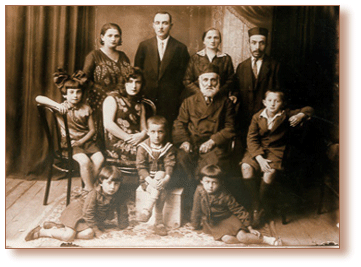
Shlomo Zlotnik, though a widower, helped to raise and educate his grandchildren. One of his sons abandoned his
wife and daughter and ran away to America; a daughter of Shlomo’s died in childbirth. The photo was
taken in honor of Dora Zlotnik’s aliyah to Eretz Israel.
Standing, right to left: Yitzhak Broide and wife Hayya Fradl (née) Zlotnik), Honeh Michalowski and wife
Bluma (née) Zlotnik).
Center row, right to left: Yankele Sheshko, Reb Shlomo Zlotnik, Dora Zlotnik, and Sarah (Sorke) Michalowski.
Front row, right to left: (first name unknown Sheshko, Moshe Sheshko, and Zelda-Bluma Michalowski.
When Hayya Fradl and Bluma attempted to escape the September 1941 massacre, they were murdered by
Lithuanian guards. Yankele Sheshko was killed by Arabs in Israel. The majority of the family was killed in the
September 1941 massacre.
Photo: Yitzhak Uri Katz. YESC, Berkowitch.
|
What many people from Eishyshok remember best about their grandparents was their tales of the past. Shlomo Farber’s maternal grandfather was a history buff, and filled his grandson’s head not just with family lore, but with accounts of local events that had significance on the stage of world history. Farber was so enthralled by what his grandfather told him during their long walks in the fields and forests around Olkenik that he became the chronicler of that shtetl, and later built an intricately detailed model of it from memory, using the woodcarver’s skill he had also learned from his grandfather. [28] In 1924–1925 Di Welt, a Lithuanian Jewish newspaper, published a series titled “From My Grandfather’s Memory,” which consisted of Shaul Kaleko’s retelling of his grandfather’s stories about nineteenth-century Eishyshok.
The older generation made sure the young people knew about their ancestors, so that they might carry on the good name of their family and continue its traditions. During the summers Moshe Kaganowicz spent with his maternal grandparents on their farm in the 1910s, they told him about his great-grandfather’s conversion to Judaism, and about his reputation for hospitality to those in need, which they in their turn were continuing, and which eventually became his own model. Grandparents also hoped that the recounting of family history would instill pride in their descendants, perhaps even inspire them to hope for the day when they could reclaim what once had been theirs. It was in that spirit that Hayya Kabacznik Sonenson made a ritual of telling her grandchildren, every Saturday at dusk, that all the land as far as they could see had once belonged to her family.
|
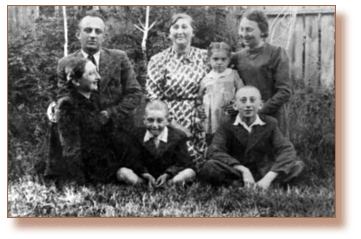
Alte Katz (center in 1941) with her two grandchildren and other family members who lived in Eishyshok:
daughter Shoshana Katz (upper right), granddaughter Yaffa-Sheinele, and son-in-law Moshe Sonenson
(seated, right to left) son Avigdor Katz, grandson Yitzhak Sonenson, and his mother Zipporah Katz
Sonenson. Memories of their grandmother’s love helped Yitzhak and Yaffa through terrible and lonely years.
When they became grandparents themselves, Alte was their role model. Moshe Sonenson and his two
children survived the Holocaust; Alte Katz and three of her children were murdered in the September
massacre;Zipporah was murdered post-liberation by the A.K.
Photo: Ben Zion Szrejder. YESC, Y. Eliach.
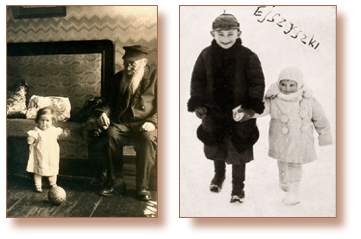
LEFT PHOTO: Yossef Ginzberg and granddaughter Tamar, May 1935. Yossef was murdered in Ponar, Vilna.
Tamar survived the war, in Siberia. YESC, Glombocki.
RIGHT PHOTO: Yaffa-Sheinele was named after her paternal grandfather, Shael Sonenson, her brother
Yitzhak Uri after his maternal grandfather Yitzhak Uri Katz. Their mother Zipporah was convinced that
both of her children had inherited the personalities of their namesakes and that her daughter was too much
of a tomboy. Both children survived the Holocaust.
Photo: Ben Zion Szrejder, Winter 1940. YESC, Y. Sonenson.
|
For their part, children were expected to be at their grandparents’ side whenever needed. If Grandfather was too frail to walk alone to the beth midrash, a grandson would accompany him there, offering him his arm in support. If the old man’s eyes were failing, his grandson was there to read to him from the Talmud; if his hands trembled, the grandson rolled his cigarettes for him, or cut tobacco for his snuff box. Similarly, a girl would assist her grandmother with the bookkeeping for the family business, would thread her needle for her, would sit next to her in the women’s gallery at shul and repeat the words of the maggid’s sermon.
The grandchildren were responsible for their grandparents’ physical comfort and well-being too. If it was cold at night, a boy might sleep in the same bed with his grandfather, a girl with her grandmother, so that the old people were kept warm. When the grandparents were sick, their devoted grandchildren nursed them through their illnesses. And on their deathbeds, too, they were attended by their grandchildren. The young people of the household were expected to be there along with everybody else when their grandparents closed their eyes forever. It was “for the honor of the dead and the memory of the living.” With watchful, curious eyes, in awe and fear, many a young child observed the ceremony that provided the final confirmation of death: the feather placed next to the mouth, proof that breathing had stopped.
Grandparents who died before their grandchildren could know them were often memorialized in their grandchildren’s names. A child who carried a grandparent’s name was expected to bring honor to the ancestor, to learn about him or her and pass that knowledge on, and to visit the grave, even if it was in another town. Some believed that a child would embody the character of the grandparents for whom he or she had been named. Thus it was common for parents who had named their children after their own parents to show them special preference. Yaffa-Sheinele Sonenson, named for her paternal grandfather, Reb Shael Sonenson, was the apple of her father’s eye, just as her brother Yitzhak Uri, named for his maternal grandfather, was the pride of his mother. Yaffa seemed to her mother Zipporah to have inherited Reb Shael’s outspoken, dynamic ways, and thereby to have been turned into a tomboy. Zipporah always felt that if her daughter had been named after her own maternal grandmother, Rivka Dwilanski, she would have been a more ladylike little girl.
______________________ |
|
|
| 27 |
The
edition of the Haffetz Hayyim’s Sefer
Ahavat Hessed published
in New York by Pardes in 1946, for example, contains a “strict
warning” that nobody can publish this or any other
of his books, in this or any other country, without the
permission in writing of Rebbetzin Freide Kagan (his second
wife) and Rabbi Aaron Kagan (his son by his second marriage.)
|
| 28 |
The
model of Olkenik was made for the Museum of Kibbutz Lohamei
ha-Gettaot (Ghetto Fighters House), Israel.
|
|
« Previous Page | |
|
UP
|