THE JEWISH MATRIARCH
In the Eastern Europe of the seventeenth, eighteenth, and nineteenth centuries, as many generations of sons-in-law were quick to discover, the shulhoyf and the larger worlds of business and public affairs were, as ever, the man’s kingdom, but the home and its more modest commercial enterprises were definitely the woman’s domain. Indeed, the matrilocal organization of the shtetl household was at the core of the kest system, and thus a woman in the household of a family oriented toward scholarship was in a particularly strong position. [12] As the main breadwinner, she had considerable power, power that had its roots in the early days of her marriage, when she was just beginning to develop some kind of business with which to support her family and thereby enable her husband to study without interruption. Even if she turned out not to be the sole breadwinner in the family, it was expected that she supplement the income of her husband. This expectation was so much the norm that the appointment letter for a shtetl rabbi, for example, usually stipulated the economic enterprise that would be allotted to his wife. Typically the rebbetzin was given exclusive rights to sell yeast, or candles, or kiddush and havdalah wine.
|
While it was particularly common among the klei kodesh (holy vessels) and the lomdim (learners) for the wife to play a pivotal role in economic matters, women were important economic partners in all social classes of the shtetl from at least the seventeenth century. The strong-willed, outspoken Jewish woman has been a staple of Jewish humor and literature ever since, an inexhaustible source for East European authors and their literary descendants. The nineteenth-century Yiddish playwright Jacob Gordin, who was as popular in Eishyshok as he was on the stages of Warsaw, Vilna, and even New York, made a notable contribution to this genre, the much-beloved Mirele Efros (1898). Based on the true story of a woman from Grodno, his play recounted the decline and fall of the fortunes of a very wealthy woman who ran the family business with a strong hand, and managed to remain the practical as well as the emotional and spiritual center of her family even as her financial base dwindled. Though few women had Mirele’s kind of money, many displayed the same kind of strength. And always there were mixed feelings about such women.
Haskalah writers advocated taking women out of the marketplace and letting men assume the financial responsibility for their families. (This didn’t stop the acclaimed Hebrew writer Avraham Mapu from commending a young woman’s business skills as one of the qualities that would make her a suitable match for his brother in 1862. Presumably he was a practical man, who was able to overlook certain principles of the Haskalah when the well-being of his brother was at stake.) [13] |
 Reuven-Beinush Berkowitch and
his wife Rachel Kabacznik, whom
he married after the death of his
first wife, Golde, Rachel’s sister.
David Kabacznik was eager to keep
Reuven-Beinush as a son-in-law
because of his outstanding business
talents. Reuven-Beinush and Rachel
were killed in the September 1941
massacre.
YESC, Berkowitch.
|
Some later writers, like Chaim Grade (1910–1982) and the Zionist leader Vladimir Jabotinsky (1880–1940), overflowed with praise for their hardworking mothers, recalling them as vigorous, vital women who had been willing to take on difficult and even demeaning work in order to provide for their families and, specifically, to earn money for their children’s education. [14]
|
Shtetl humorists had a field day with the phenomenon of the powerful woman, their jokes reflecting the discomfort men felt in the presence of such women — though the women they disparaged were always wives, not mothers (power in a wife being much more unnerving, apparently). Lines like the following are representative of their “wit”:
Even a wife as big as a flea can sting.
One could live in peace, if not for the wife and the flies.
Eve had long hair but she made Adam’s life short.
Twice in a lifetime a wife is dear to her husband: on
her wedding day, and during her funeral.
When a wife wears the pants, the husband launders the dress. [15]
Perhaps an old Romanian proverb best sums up the traditional man’s view of the ideal woman, who was not at all like the women of the shtetl: “A woman should be like the moon: shine at night and disappear during the day.” The shtetl woman had too much to do to disappear during the day, as those who benefited from her efforts knew very well.
|
Nonetheless, her position was ambiguous, for her prominent role in the household and the marketplace was not reflected beyond those confines, nor was it officially acknowledged within them. Shtetl women were identified as housewives, and rarely appeared in any official documents as the proprietors of their businesses, even when they owned those businesses and ran them single-handedly. The clarity with which all the shtetl’s social and religious roles and responsibilities were defined for men and women, husbands and wives, boys and girls gave way to gray zones when it came to the home. Family life with the exception of those religious rituals that were part of it, was left to the discretion of those who lived it, which did not necessarily benefit women. Even as late as the seventeenth century there still lingered a perception that a woman was simply property, that a man owned his wife (and children) outright — an error that seems to have been common enough that the Lithuanian Council made a point of condemning it, and in very harsh terms: “A man who will commit evil to enslave his wife, son, or daughter in a debt to a non-Jew or who, even worse, actually hands over his wife and daughters to a non-Jew because of debt — his blood is on his head.” [16]
By the nineteenth century, woman’s legal status may have been clearer, but her image was still problematic, current realities not matching up with the ancient customs and beliefs. Hence the complaint of Reina Batia, first wife of the Neziv, who objected to the blessing recited every morning by the men in the synagogue: “Blessed are you, Our God, King of the Universe, for not having made me a woman.” Speaking not just as a woman but as an accomplished scholar and an important participant in the administration of her husband’s yeshivah, she was indignant:
Every man, including the simplest, most uneducated man who does not
even understand the meaning of the blessing, who would not dare to cross
the threshold of my home without my permission, proudly recites that
prayer daily. To add insult to injury, I must respond “Amen!” Who can
sustain such an eternal insult to women?[17]
It’s not surprising that the result of these mixed messages about the role of women was often frustration and resentment on the part of the wife, anger and insecurity for the husband. Many a marriage was marred by years of silent brooding, or harsh verbal exchanges — or worse.
|
| The strains only grew more severe in the twentieth century, especially after World War I, when the majority of shtetl men emerged from the cloistered depths of the beth midrash and the yeshivah to go out into the marketplace. With women proving reluctant to yield their prominent place in the shtetl economy and the world beyond, and men eager to consign their wives to the homemaker role as they took on the breadwinner role, the competition between the sexes was heightened. Women who refused to cede power were looked upon with contempt, and labeled shrill, aggressive, even ruthless. Hence the increasingly common portrait of the Jewish woman as a shrew, a conception that lives on to this day, passed along by writers who might seem far removed from the shtetl, but are nonetheless carriers of its legacy. In a work like Philip Roth’s novel Portnoy’s Complaint, the resentment against women has generalized beyond wives to mothers — perhaps because at the time Roth was writing about, the 1950s, the once-powerful Jewish woman had been effectively eliminated from the marketplace and therefore had no outlet for her considerable energies and talents. |
No doubt the American immigration process contributed to the problem. For reasons that are not entirely clear, women who emigrated from the shtetl to America were glaringly absent from the public worlds of business and philanthropy in their new land. Perhaps because their husbands usually preceded them there by some years, it may have seemed natural for women to allow their more acclimated, experienced spouses to assume the major responsibility for earning a living, while they themselves were relegated to supporting roles. Having made up the majority of the shopkeepers and been the very backbone of the market-day economy — in Eishyshok as in many other places — they disappeared from sight in America. [18]
One of the very few émigré women from Eishyshok who retained that special shtetl flair for business was Lena Kaganowicz, who moved at the age of fifteen in 1909. She began as a seamstress living on the Lower East Side and doing piecework at home for $3 a day. Later she became a contributor to “A Bintel Brief” (A Bundle of Letters), the letters column that ran in the Jewish Daily Forward, her special subject being the plight of the working woman on the Lower East Side. [19] Ostensibly a forum for recent immigrants to ask an editor for advice about their various problems, the column sometimes ran short of real letters, in which case it commissioned them. Lena, a woman with an excellent command of Yiddish and a fine epistolary style, was one of their writers. She and her husband later moved to Spedden, a small town near Edmonton, Alberta, where they opened a general store that was highly popular with the local Ukrainian settlers as well as with the Cree Indians who lived on two nearby reservations. Although she was a very successful businesswoman and the mother of four daughters, Lena was one of those shtetl-style women who always had time for everything and everybody.
Of course, this could only have been because she worked incredibly hard. For the women in the shtetl there was no pause in the demand for their labor, no escape from the relentless grind of daily life. Regardless of class or even of individual temperament, the shtetl woman worked virtually nonstop, from early dawn until late at night. When shopkeeper Malka Roche’s Schneider opened her store in time to serve the members of the minyan vatikin, those pious men who prayed each day at sunrise, she knew she was not the only one hard at work. Amid the clatter of boots against cobblestones, as the men made their way to the beth midrash, she could hear the sound of streams of milk flowing into tin and wooden pails, for this was the hour when the shtetl women milked the family cow. Against the dark skies, they could see smoke already issuing from most of the shtetl chimneys, could catch a whiff of Rivka Dwilanski’s famous bagels being baked at No. 13 Marketplace, perhaps even pick up the smell of whatever Feige Demitrowski had put into the oven of her bakery at the corner of Vilna Street. And these women were the rule, not the exception.
No shtetl son or daughter could ever recall seeing their mother asleep. When the children went to bed their mother was still working; when they woke up in the morning she was already at it again. Moshe Kaplan, born in 1915 in a town near Eishyshok, describes his mother’s daily routine:
My mother was a housewife (for lack of a more accurate word) and she worked hard all her life.
She got up at three o’clock in the morning to milk the cow and
to take her to pasture with the shtetl’s communal herd. Then she stoked the fire in the oven, cooked, and baked bread, pastry,
and donuts.
When she finished her household chores she worked in the family
vegetable garden consisting of about 2.5 acres in back of
our home.
In 1922, Mrs. Kaplan, the mother of six young children, was widowed. To support her children and provide for their education, she leased an additional patch of land from a Christian villager so that she could grow more vegetables to sell. During the winter months she sold clay pots, pitchers, pans, and bowls to the villagers, transporting them from the factory to her customers’ homes with the help of her son Moshe. In the late 1920s another son, Asher, was arrested for Communist activities and was sent to the Vronki prison for political offenders. Out of her modest income she managed to find enough to send him a weekly food parcel, but the strain of it all was too much for her. She died in 1932, with Moshe at her bedside. [20]
The hardships of Mrs. Kaplan’s life may have been more extreme than many, but they were not atypical. Most women ran a business while simultaneously managing a large household.
The average shtetl woman raised between ten and twelve children, cared for aging parents and other relatives, and looked after the kest couples and their children. The businesses of many of them were located in the home, which may have been convenient in some ways, but also contributed to the overcrowding that was so common in shtetl households. The melamed’s wife would have her little wig workshop in one corner of the house’s main room, which was also her husband’s classroom. Another woman might have a dressmaking business in her home. Alte Katz’s household, with a bakery below street level, a drugstore adjacent to the living quarters on the first floor, and a photography studio on the second floor, was unusual, this being far more space than most people had, even if it did have to accommodate a home and three businesses.
In the artisan class, the husband’s workshop would be in the house or attached to it, so that it was normal for three generations of family members to be living and working in the same room along with the workshop apprentices. The husband’s constant presence often added greatly to the tensions of the household. Women looked forward to prayer time as a welcome respite, for all the men in the household would leave for the beth midrash as the hour approached. Similarly, women whose husbands were seasonal workers — builders, roofers, carpenters — were known to breathe a sign of relief when winter came, for then they could count on their husbands spending long hours away from home sitting and learning in the beth midrash.
Some women had problems of a different sort. Their husbands, sole or joint proprietors of the family business, were often away on long business trips. Due to a combination of bad weather and primitive roads and transportation, these absences could last weeks or even months, during which time the women in the family had to take over, shouldering yet another burden.
__________
|
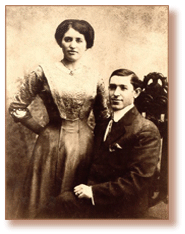
Lena Kaganowicz with her future
husband, Morris Rosenberg,
in New York City. Even after
emigrating to America in 1909, at
the age of fifteen, she retained her
special shtetl female flair for
business.
YESC, Jean Rothstein.
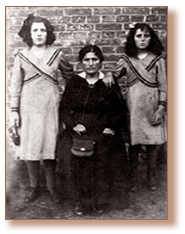
Zlate Koppelman with two of her
daughters, Nehava (left) and Leah.
They assisted her at home and at
work, especially after the death of
their father, Elisha. Nehama and
Leah made aliyah to Eretz Israel.
Zlate was killed in the September
1941 massacre.
Photo: Yitzhak Uri Katz.
YESC, N. Frischer.
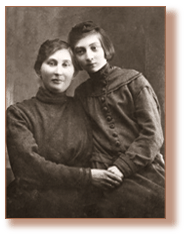
Alte Katz with her oldest daughter,
Zipporah (Feigele). Zipporah helped
her mother in raising her siblings
and educating them. She also
assisted professionally in the photo
studio after the death of her father,
Yitzhak Uri Katz. Alte was killed
during the September 1941
massacre. Zipporah was murdered
by the AK post-liberation.
Photo: Yitzhak Uri Katz.
YESC, Y. Eliach.
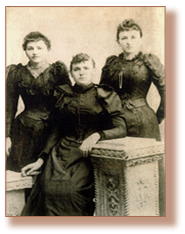
Three of the daughters of Nehemia
der Feldsher, who sought a new life
in America in the 1890s: Margolia
(Cohen) (left), Lilly (Sirk), and
Annie (Foster).
Photo: Green, Boston.
YESC, R. Rosenblatt.
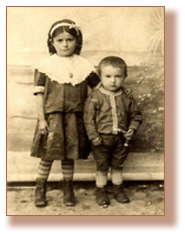
Feigele (Fanichke) and Velvke Saltz.
Shortly after their mother’s death,
their father emigrated to America.
Feigele was devoted to her brother
and helped to raise him. Years later
both joined their father in America.
Photo: Kalinowitch, Ivie.
YESC, Shultz-Saltz. |
|
|
| 12 |
Etkes,
“Marriage and Torah Study,” pp. 166–170.
|
| 13 |
A.
Mapu, Mikhtavim, p. 185.
|
| 14 |
Grade,
My Mother’s
Sabbath Days; Nevada,
ed., The
Image of the Woman as Seen by V. Jabotinsky
(English title),
pp. 51–54.
|
| 15 |
Yahadut
Lita, vol. 3, pp.
593–594.
|
| 16 |
Pinkas
Vaad ha-Kehilot be-Lita,
1623/44.
|
| 17 |
Epstein,
Mekor
Barukh, vol. 4,
chapter 46.
|
| 18 |
On
the lives of women in the immigrant generation, see Glenn,
Daughters
of the Shtetl,
and S. Weinberg, The World of Our Mothers.
|
| 19 |
Some
of the letters written to the Jewish
Daily Forward over
a period of sixty years, including a number by Lena Kaganowicz,
were collected and published in book form: Isaac Metzker,
ed., A
Bintel Brief, Ballantine
Books, 1972.
|
| 20 |
Moshe
Kaplan, Korot
Hayyai (unpublished
manuscript), pp. 10-11, 19, translated from the Hebrew,
Israel, 1973. I am grateful to Dr. Motti Melamud and Zippi
Avrahami Melamud for entrusting me with their uncle’s
manuscript.
|
|
« Previous Page | Next Page »
|
|
UP
|