THE FAMILY UNITS OF THE SHTETL WERE USUALLY MATRILOCAL IN NATURE: The pattern in Eastern Europe, dating from at least the seventeenth century, was for young couples to establish their first household in the home of the wife’s family.
From the sixteenth century on, the ideal husband for an Eastern European Jewish girl was the scholar, the diligent, promising yeshivah student. Hence the criteria for the bride were that she be the daughter of well-to-do parents who were eager and able to support the scholar and his young family during the early years of their marriage, in an arrangement known as kest. Offering kest allowed the husband to continue his studies, while the bride, ideally an industrious, strong, healthy young woman, established a business of her own that would eventually enable her to take upon herself the financial responsibility for her husband and their children. During this period, the wife (and sometimes her husband) might receive training in the family business, as preparation for becoming a worker or a partner in it, or might learn a craft or a trade, or might do agricultural work. The duration of the kest period was according to the husband’s level of scholarship. The greater the scholar and the higher the hopes for his intellectual growth and achievements, the longer the kest.
If the newlyweds did not actually reside there, they usually lived close by and ate their major weekday meals as well as all their Sabbath and holiday meals there. Instantly the bridegroom became a member of a new extended family, with its own customs, quirks, and complexities. [1] Often it included three generations under one roof, for kinship responsibilities were extensive, and often the mix was further complicated by stepchildren from earlier marriages that had ended either in death or — rarely — divorce.
|
SONS-IN-LAW
For the new husband, this period could prove a very difficult adjustment. Though a proverb held that “a son-in-law can do no wrong,” this was one of those sayings more honored in the breach than the observance, describing an ideal but seldom realized situation in which the bride’s parents endlessly admired and pampered their beloved son-in-law, the highly esteemed scholar. In reality, sons-in-law were perceived as doing wrong much of the time, and treated accordingly. And the treatment must have seemed all the worse by contrast with the adoration they had received in their own homes growing up. |
Thus many a young son-in-law found it difficult to fit into his wife’s
family. The letters that one Shmuel of Kelme, Lithuania, wrote to
his newly-married son, Arieh-Leib, in the nineteenth century offer
a glimpse into the resulting pain of both the young man and his
parents.
My son, beloved of my soul! I heard a rumor, and
my stomach was upset, that your father-in-law and
mother-in-law (perhaps your spouse as well), and your
father-in-law’s entire household, are at odds with you.
You never mentioned it to us — and you did not tell us
that you are belittled in your father-in-law’s house, and
they do not pay attention to you.
In this case, it was the mother-in-law who played a major role in
the problems. She insulted Arieh-Leib by casting doubt on his
scholarly abilities, which she deemed inferior to those of her own
sons. And she so upset her daughter that Shmuel believed the
miscarriage the young woman had recently suffered was the result
of all the grief her mother had caused. [2]
CHILD BRIDES AND GROOMS
The Talmud dictated that the father of a daughter should seek to
marry her off at a young age, anytime from twelve on; if she did
not marry young she might break the commandments and become
unchaste. [3] This practice of encouraging marriage at an early age
has remained a constant feature in traditional Jewish society, owing
not just to moral concerns about chastity, but to a variety of
economic, cultural, and political circumstances. For example, during
the cantonist period 1827–1856, when the tsarist army was drafting |
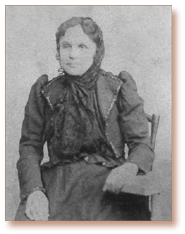
Hayya Sonenson, mother of Reb
Shael Sonenson, in the 1870s.
She was a typically powerful
Lithuanian matriarch: in command
at home, successful in her business,
and even known for her scholarship.
After her son Shael married Hayya
Kagacznik, he called his wife Haike
to distinguish her from his mother.
She was Yaffa Eliach’s paternal
great-grandmother.
(Yaffa Eliach Shtetl Collection
[YESC], M. Sacharoff) |
Jewish males as part of a pattern of anti-Semitic persecution, boys as young as their early teens,
and sometimes even younger, were married off so that they could avoid army service. Fear of
government decrees attempting to delay Jewish marriages — some of them real, some only rumors —
merely results in a flood of such rushed early unions. The legal literature of the time reflects both the
public and private aspects of this phenomenon, and the considerable suffering it caused. [4]
The younger the son-in-law, the harder the adjustment was likely to be; a groom who was virtually a child had few defenses or resources to fall back on. A teenage husband who was regarded as a budding scholar of promise at the yeshivah might be treated as a spoiled brat who needed to be disciplined in the home of his in-laws, with mothers-in-law often doing the disciplining.
The philosopher Salomon Maimon (1753–1800) was a child prodigy who was born in Lithuania and married off –being quite a prize – at the age of eleven. In his autobiography, he described himself as “under the lash of my mother-in-law” and recounted the indignities she visited upon him, which included not just her refusal to honor her financial obligations to him and the way she begrudged him his very meals, but physical attacks as well. “Confident by reason of my youth and want of spirit, she even ventured now and again to lay hands on me.” [5] Another story, dating from around the same time, concerned a twelve-year-old boy (referred to in the responsa literature describing these events as a “babe”) who married an equally young girl. Since the bride would not permit her husband to touch her, the marriage remained unconsummated. When their failure to have sexual relations was attributed to her husband’s refusing her on the grounds that she wasn’t a virgin, however, she yielded to pressure and agreed to fulfill her marital obligations. Unfortunately, the couple was interrupted by a knock at their door as they were trying to perform the act, and from that day on, the humiliated youngsters avoided each other. Shortly after his fourteenth birthday the husband disappeared, leaving his wife an agunah (a deserted woman who cannot remarry since she was never granted a divorce.) [6]
Even the brilliant scholar Naftali Zvi Yehudah Berlin (1817–1893) was not immune to the miseries and mortifications of early marriage. When the Neziv, as he was later known, was a thirteen-year-old student at the Volozhin yeshivah, he married the daughter of the head of the school. The young man’s intellectual development was very closely supervised by his in-laws and, alas, found wanting, perhaps because the pressure was simply too much for him, with the result that he was not allowed to sit at the table with the family for Sabbath and holiday meals. His humiliation seems not to have robbed him of hope, however, for he worked all the harder at his studies and finally succeeded, at age sixteen, in being re-invited to the family dinner table. In later life, as a world-renowned scholar and religious leader, now head of the Volozhin yeshivah he had once attended, he used his authority to speak out against early marriages, which he opposed on medical grounds. [7] His father-in-law, Reb Itzele, continued to favor them. Attending a conference of rabbis in St. Petersburg in 1843, Reb Itzele was questioned about the practice by a priest who was well known for his hostility towards Jews. Rab Itzele responded with a smile: “Ever since the events of some 1,800 years ago when a Jewish girl reached maturity and did not marry, with results that have been calamitous to us from that day forth, we have been seeing to it that our daughters are married off young.” [8]
In the closing decades of the nineteenth century, the phenomenon of early marriages sharply declined. The average age of unmarried students at the Lithuanian yeshivot rose to twenty, and eventually twenty-five. Older grooms found it much easier to be more assertive with their in-laws and with other members of the extended family. And if life at home was still unbearable, there was always the option of spending most of one’s time at the yeshivah. This conception of the academy as a refuge from an unhappy marriage is reflected in the old Lithuanian proverb “A man does not become a parush if he is married to a pretty wife.” [9]
In many households, of course, sons-in-law were warmly and lovingly welcomed, even in some cases held in so much esteem that their in-laws tried to keep them in the family after their wives had died. When Reb Hayyim Paltiel, the shtetl dayyan, lost his wife, her parents acted swiftly, matching him up with a cousin of their deceased daughter. His marriage to Alte meant that they would continue to have a renowned and saintly scholar in their family, for which they were most grateful.
For David Kabacznik, holding on to a son-in-law was a matter of good business rather than scholarship. When Reuven-Beinush Berkowitch, son of Reb Itche der Shammesh, married Golde Kabacnik, the beautiful blond daughter of Reb David, he proved a great asset to the family business, which consisted of supplying the Tzar with horses and fodder for his stables, and geese for his table. With his fluency in Russian and Polish as well as several local dialects, Reuven-Beinush made an excellent buyer, and when his wife died in childbirth, her father immediately married him off to his other pretty daughter, Rachel. Not that Reb David’s appreciation for his son-in-law found any material expression. The Kabacznik family exploited their great find, paying Reuven-Beinush meager wages, sending him out on lengthy buying trips, and keeping him and his family, which came to number five sons and a daughter, in a state of abject poverty. When it came time to find his own daughter a husband, Reuven-Beinush had to sell his home to provide a dowry for her, after which he lived in a small rental apartment on one of the side streets. Since he was not flesh and blood of the Kabacznik clan, they never made him a partner. But the unhappy son-in-law in a matrilocal family structure had few options — for all that the larger structure of the society was patriarchal.
Indeed the Jewish family has been described as basically patriarchal from biblical times on, though there has always been some degree of acknowledgment of the wife’s role. [10] After all, God did tell the patriarch Abraham, with regard to the first Jewish matriarch: “In all that Sarah hath said unto thee, harken unto her voice. [11] Through the millennia, God’s conversation with Abraham has received many interpretations, depending on both time and place, and both the position of the Jewish matriarch and the pitch of her voice have varied accordingly.
__________________ |
|
|
|
| 1 |
According to S.D. Goitein’s work on Jewish life in the Mediterranean basis between the tenth and thirteenth centuries, however, the Jewish family there was both patriarchal and patrilocal. Young couples established their households in the husband’s father’s home, which was usually in an extended-family compound. And the patriarchal, patrilocal family that Goitein describes as prevalent in medieval Egypt had much on common with the traditional Moroccan Jewish family of the eighteenth and nineteenth centuries. In Morocco, as in Aleppo, Syria, and in other Jewish societies in Muslim countries, Jewish women were largely confined to the home, with the men being responsible even for food shopping in the local market. See Goitein, A Mediterranean Society: The Jewish Communities of the Arab World as Portrayed in the Documents of the Cairo Geniza, vol. 3, The Family; and Deshen, “the Jewish Family in Traditional Morocco.”
|
| 2 |
Etkes,
“Marriage and Torah Study Among the Lomdim in Lithuania
in Lithuania in the Nineteenth Century,” pp. 158-159.
|
| 3 |
Leviticus 19:29; Sanhedrin 76/2.
|
| 4 |
R.
Ha-Kohen, Torat
Yekutiel; Lithuanian
Council of 1761; for a comprehensive essay on the subject,
see Halpern, Eastern
European Jewry,
pp. 289–309.
|
| 5 |
Maimon,
An Autobiography,
pp. 31–33.
|
| 6 |
Landau,
Noda
be-Yehudah, Sect.
2, Q52, pp. 45–46.
|
| 7 |
N.
Berlin, Ha-Amek
Davar, commentary
on Exodus 1:7.
|
| 8 |
Leoni,
ed., Wolozin,
p. 106.
|
| 9 |
Yahadut
Lita, vol. 3, p.
592.
|
| 10 |
De
Vaux, Ancient
Israel, pp. 19–55.
|
| 11 |
Genesis
21:12.
|
|
« Previous Page | Next Page » |
|
UP
|